Buying one gift for two people sounds simple until you start trying to make it personal.
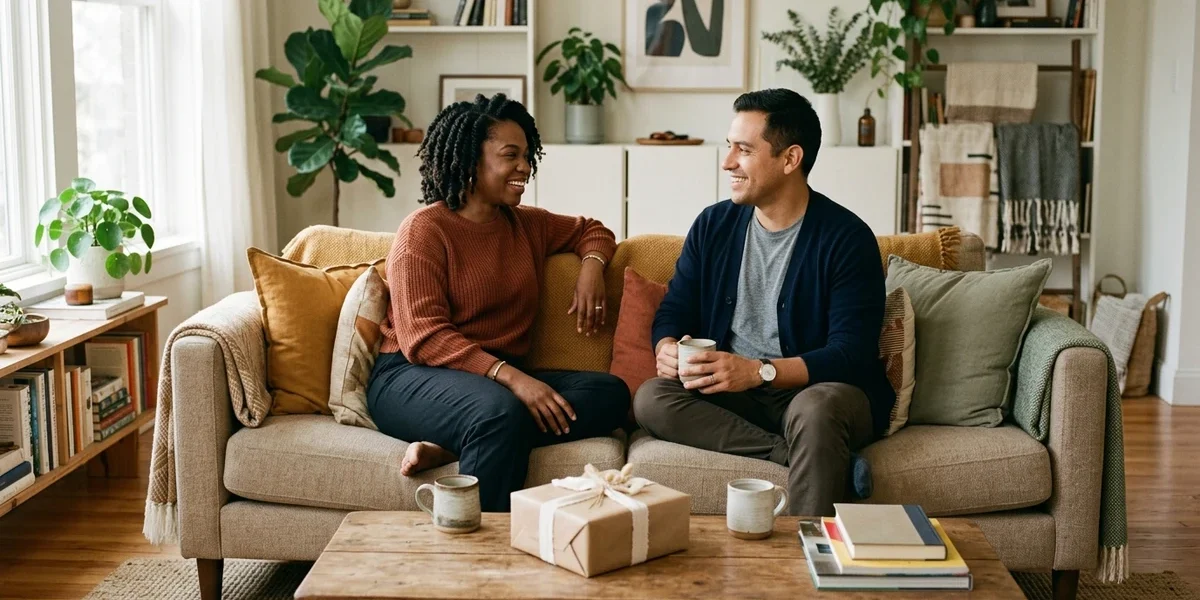
A couple who already shares a home may not need another generic household item. What can make a gift more thoughtful is a detail that belongs to their life together: both names, a date they care about, the place where something important happened, or a small reference to the home they have built.
The key is to choose the shared meaning before the product.
That gives you a useful filter for personalized couple gift ideas and helps avoid a common mistake: choosing something that technically includes two names but still feels as though it was designed for only one person.
Start with what the gift should celebrate
Before deciding what to buy, decide what the gift is actually about.
For a couple, there are usually two useful directions.
The first is their relationship. An anniversary, wedding date, first meeting or another shared milestone may be the important part of the story.
The second is their shared home. Perhaps they have recently moved in together, settled into a new city or reached the point where a particular place has become “ours” rather than “mine” or “yours.”
Those ideas overlap, but they do not create the same gift.
An anniversary gift can look backward to a meaningful point in the relationship. A new-home gift may be more about the chapter they are beginning now. For a couple who has lived together for years, the most relevant detail might be neither—it could simply be something that reflects an everyday part of the life they share.
If you are shopping across several kinds of family relationships, a broader family gift ideas for relationships guide can help you choose the right recipient direction before narrowing the personalization.
Choose the shared detail before the product
Personalization has more impact when the detail itself means something.
Instead of asking, “What can I put their names on?” start with a different question:
What would both of them immediately recognize as part of their story?
For many couples, the answer falls into one of three categories: names, a date or a place.
Use names when the couple’s shared identity is the point
Two names can be the simplest choice because they make it clear that the gift belongs to both people.
This works especially well when the gift is meant to celebrate the couple as a pair rather than one specific event.
You do not need a shared surname to make this work. In fact, using both first names or the names the couple actually uses can be more personal than automatically turning the design into a family-name gift.
That matters for unmarried couples, married partners who kept different surnames, same-sex couples, couples from different naming traditions and anyone who simply prefers to be represented individually.
For example, a design built around “Alex & Jordan” says something different from a design based on “The Smiths.” Neither approach is inherently better. The useful question is which one actually reflects the people receiving it.
Use a date when the gift is tied to a milestone
A date gives the personalization a specific reason to exist.
For an anniversary gift, that might be a wedding or partnership date. For a couple celebrating a shared home, a move-in date may be more relevant. Another couple may care more about the day they met, became engaged or reached a milestone known mainly to them.
The strongest date is not necessarily the most formal one.
Choose the date the couple themselves would regard as meaningful.
If you are unsure, avoid guessing. A beautifully designed gift with the wrong date is still wrong.
This is also where restraint helps. A name plus one meaningful date often communicates more clearly than trying to fit every important event into one design.
Use a place when location carries the story
For some couples, a location says more than a date.
It might be the city where they met, the town where they married, a neighbourhood they associate with an important chapter, or the place where they now share a home.
A place can be particularly useful for couples who have recently moved in together because it celebrates the transition without requiring traditional marriage or family wording.
It can also work when the couple has lived together for years but still feels strongly connected to a particular city, hometown or destination.
Be thoughtful about privacy. A city, town, neighbourhood or meaningful public place can often tell the story without putting a private residential address into a design that may be displayed or shared publicly.
Match the personalization to the occasion
The same couple may suit a different gift depending on why you are giving it.
For an anniversary, lead with the relationship
An anniversary naturally points toward shared history.
Names plus a meaningful date are a straightforward combination, but they are not the only option. A place connected to the relationship can be equally relevant, especially if the couple associates an anniversary with where they met, married or began their life together.
Think about what the occasion is asking the gift to say.
If the message is “look how far you have come together,” a relationship milestone makes sense.
If the message is “this place has become part of your story,” location may do more of the emotional work.
For a new home, lead with the new chapter
A couple moving into a shared home is creating routines as well as decorating rooms.
That makes new-home personalization slightly different from anniversary personalization. Instead of focusing only on romance, you can acknowledge the life they are building together.
Names may work. A move-in year may work. A city or general location may work.
What matters is that the detail connects both people to the new chapter.
Be cautious with phrases that assume home ownership. Plenty of couples build meaningful homes in rented houses, flats or apartments. “Our home” can be more inclusive and accurate than wording that implies they have purchased a property.
For an everyday gift, look at their routines
Not every personalized couple gift needs a major milestone.
Sometimes the better clue is what they actually do together.
Perhaps they enjoy quiet evenings at home. Perhaps they host friends regularly. Perhaps they both work from home, spend weekends travelling or have a particular room they have made their own.
You do not need to turn every hobby into a theme. The purpose of thinking about routines is simply to choose a gift that has somewhere to belong in their life.
A personal detail attached to something that fits their habits will usually make more sense than a highly sentimental design they have nowhere to use or display.
Decide where the gift belongs in their life
Before choosing a format, picture what happens after the gift is unwrapped.
Will it belong in a space they both use, fit into an everyday routine, or be kept mainly as a reminder of a particular moment?
A gift intended for a common room has to work in a space shared by two people. Something connected to individual routines should make sense for each partner without assuming that their tastes or habits are identical. A keepsake, meanwhile, can be meaningful without needing to become permanent décor.
This perspective is more useful than assuming every couple needs either a single household object or a matching pair.
Think about what role the gift will actually have in their life.
If it will be displayed, consider whether both people are likely to enjoy seeing it in their shared space. If it will be used, consider whether the format fits a routine they genuinely have. If it is primarily sentimental, it may not need to be large or highly visible to feel important.
The goal is not perfect symmetry between two people. It is choosing something whose meaning genuinely belongs to both of them.
Personalize for both people, not around assumptions
The easiest way to make a personalized gift feel impersonal is to rely on a label the couple does not use.
Before ordering, consider whether the wording assumes:
- they share a surname;
- they are married;
- one partner should be listed first;
- they own their home;
- they have children;
- they use traditional husband-and-wife roles;
- one person’s preferences represent both people.
Personalization should reflect the recipients, not force them into a template.
If they use different surnames, first names may be the natural choice. If the couple does not make a big deal about an anniversary date, a shared location may be more meaningful. If they are private people, subtle personalization may suit them better than a long romantic message.
This is also why there is no universal “most personal” option.
Specificity matters more than formality.
A simple way to choose between names, a date and a place
If several ideas feel possible, use this quick comparison.
| Personalization | Best when | Ask yourself |
|---|---|---|
| Names | The gift celebrates them as a pair | Do both people use these names comfortably? |
| Date | A milestone is central to the occasion | Which date would they choose themselves? |
| Place | A home, city or shared location carries the story | Is there one place they both associate with this chapter? |
| Names + date | The occasion and the couple are equally important | Will the combination stay clear rather than crowded? |
| Names + place | Their shared home or location is the main theme | Does the place have meaning for both partners? |
You do not need to use every available field.
Often, choosing one strong idea produces a more coherent gift than filling every blank simply because a customization option exists.
Think about the home before choosing a display gift
When a gift will live in a couple’s shared space, the room matters.
A personalized item can be emotionally meaningful and still be difficult to place if its style, scale or purpose does not suit the home.
You do not need to know their entire decorating scheme. A few practical questions are usually enough:
Do they display personal photos and keepsakes, or is their home more minimal?
Do they have obvious shared spaces where a personalized piece would make sense?
Would they prefer something used regularly or something primarily kept as a memory?
Are you confident about their style, or would a simpler design be safer?
This is where a little restraint can make the gift feel more thoughtful. Personalization creates meaning; it does not automatically guarantee that the item fits the recipients’ space or taste.
Keep private details private
A shared place can be a lovely personalization idea, but more detail is not always better.
There is a meaningful difference between using a city that shaped the couple’s story and placing a complete private home address on an item that may later appear in photographs or social posts.
If you do not know how the couple feels about that, choose the less sensitive option.
A city, neighbourhood, public landmark or general place name may preserve the meaning without exposing information they would rather keep private.
The same principle applies beyond addresses: use only the personal information necessary to tell the story.
Check every detail before ordering
Once you have chosen the idea, slow down for the practical part.
Personalized gifts can depend on customer-entered information, and the right checks will vary by product and seller. Before ordering, confirm the current product page supports the personalization you want.

Then review:
- the spelling of both names;
- capitalization and punctuation;
- the exact date;
- the order in which names appear;
- the wording of any message;
- the place name;
- what is actually included with the product;
- any relevant size or format choice;
- current processing and delivery information;
- the applicable change, cancellation or return terms.
Do not rely on assumptions from another personalized product. Available fields and policies can differ even between items sold by the same retailer.
If the gift is needed for an anniversary, move or other fixed date, check the current ordering information early enough to make an informed decision rather than assuming personalization will follow the same timeline as a standard item.
Let the shared story make the decision
The best personalized couple gift does not need to explain the whole relationship.
It needs one detail that feels unmistakably theirs.
Use names when the couple themselves are the story. Use a date when a milestone is the reason for the gift. Use a place when home or location carries the strongest meaning. If two details genuinely belong together, combine them—but do not add more simply to make the gift look more customized.
Most importantly, choose something that represents both people.
For couples who share a home, that often means moving away from “What can I personalize?” and asking, “What part of their life together is worth putting into the gift?”
Once you have that answer, shortlist the gift formats that fit their home and habits. Explore personalized couple gifts only where the current product page supports the details you want, and check those details before you order.