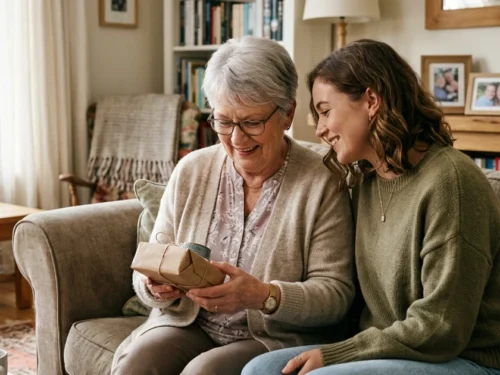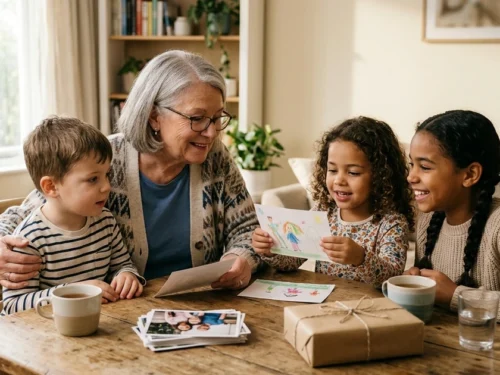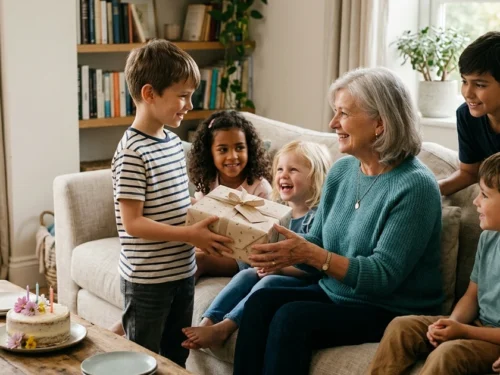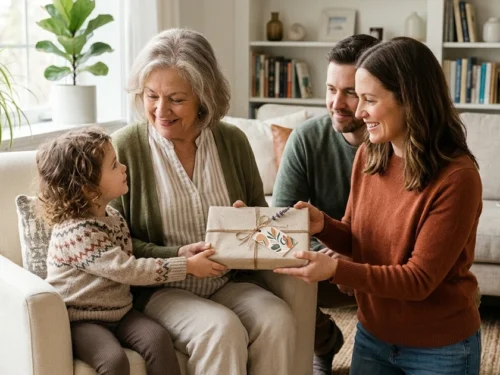
A personalized gift can feel slightly wrong even when everything else about it is thoughtful if the family title does not sound like the person receiving it.
If everyone calls her Nana, putting “Grandma” on the gift may feel oddly formal. If she proudly calls herself Granny, replacing it with a different nickname may remove the detail that makes the wording feel familiar.
There is no universally correct choice between Grandma, Nana, Granny or another name. The better choice is the one that reflects how the relationship actually sounds inside your family.
Start with the name your family actually uses
The simplest question is also the most useful: What do the grandchildren call her when nobody is thinking about the gift?
That everyday name is usually a better starting point than a list of popular grandmother nicknames.
If a child runs through the door shouting “Nana!”, a gift using Nana connects with an established relationship. If everyone naturally says Grandma, there is no need to replace it with something more unusual simply because other options exist.
The goal is not to find the most original grandmother name. It is to choose wording that feels recognizable to the people involved.
Let her preference break a close tie
Sometimes family usage is not settled.
A new grandmother may already know what she wants to be called. Another may be comfortable with several possibilities. In that situation, her preference is an important clue rather than a minor detail.
Grandparent names can come from personal preference, family tradition, heritage or even a child’s early pronunciation. Naming guides from AARP and Nameberry both show how varied those paths can be.
So if the choice is between two plausible names, ask which one sounds most like her.
For example, imagine that adult children casually use “Grandma” when talking about her, but she signs cards to a new grandchild as “Nana.” If Nana is clearly the identity she is adopting, that may be more meaningful on a gift celebrating her new grandmother role.
The point is not that the recipient always decides the name alone, or that grandchildren never shape it. It is that personalized wording should not ignore a clearly expressed preference.
Treat regional and family traditions as clues, not rules
Grandma, Nana, Granny, Gran and Nan can all appear in family life, but everyday usage varies.
Cambridge Dictionary identifies grandma, granny and gran as informal forms of grandmother, and it marks nan as British informal. That makes regional language useful context, especially for a US/UK audience, but not a rule every family must follow.
A British family may use Grandma. An American family may use Nan. Another family may use a heritage term, a nickname inherited from an earlier generation or a name created naturally within the family.
Family usage is more specific than a broad regional tendency.
If a particular title already carries years of memories, that history is usually more relevant to the gift than whether another term appears more traditional or more fashionable.
Decide whose relationship the wording represents
The right title can also depend on who the gift is from.
A gift from one grandchild may naturally use the exact name that child says. A gift representing several grandchildren may need wording that feels familiar to the group. A wider family gift may use the title everyone recognizes most easily.
Suppose one grandchild calls her “Granny” while another, much younger child has shortened it into a family nickname. Neither is automatically wrong.
Ask what relationship the gift is meant to capture.
If the gift is specifically from the younger child, the nickname may carry the most personality. If it represents all the grandchildren, the established shared title may make more sense.
Once the title is settled, readers looking for broader ideas about what the grandchildren could give her can move to the guide on personalized gift ideas for Grandma from grandchildren rather than turning the wording decision into a full gift roundup.
What if different grandchildren use different names?
Families do not always follow one naming system.
A grandmother might be Nana to one branch of the family and Grandma to another. A first grandchild may establish one title, while younger children create a variation of it. Blended and extended families can add another layer because different households may already have their own familiar wording.
There is no need to decide which group is “right.” Instead, choose the title that matches the people represented by the gift.
| Situation | Strongest clue | What to avoid |
|---|---|---|
| Gift from one grandchild | What that child actually calls her | Replacing it with a generic title purely for consistency |
| Gift from several grandchildren | Their most widely shared title | Treating one child’s private nickname as the name everyone uses |
| Gift from the wider family | The title she readily recognizes as her family role | Choosing a fashionable alternative nobody uses |
| New grandmother with no settled title | Her preference plus emerging family usage | Guessing and treating the guess as permanent |
| Family-specific nickname | The familiar version the family actually uses | “Correcting” it merely because it is unusual |
The wording should identify the relationship, not standardize the family.
Keep the spelling that belongs to the family
Personalized wording is not the place to casually change a nickname.
If the family has an established spelling, use it consistently. Check old messages, cards, contact names or family group chats if you are uncertain.
For a family-specific nickname, familiarity matters more than making the spelling look conventional. Changing a version everyone knows can make the finished wording feel less personal, even when the replacement looks more standard on paper.
Capitalization deserves the same attention. When a title is being used like a name in a design—“Love You, Nana,” for example—check the exact final wording instead of assuming someone else will know what you intended.
Consider the design context without changing her identity
A short title may fit a compact design more comfortably than a long one. That does not mean you should rename the recipient simply to make the layout easier.
Start with the relationship. Then evaluate the design.
If the wording feels crowded, check the current product description and personalization instructions to understand what that particular item allows. Do not assume that every personalized product accepts the same wording, character count or layout.
This becomes especially important when the title appears alongside other information such as grandchildren’s names, a date or a message.
The useful question is: How can this design express the right name clearly?
It is not: Which name should we substitute just because it takes up less space?
If a specific design cannot accommodate the wording you want, choosing a different design may make more sense than changing a meaningful family title.
If you already know the title you want to use, compare it with the current personalization details on the specific gift or collection you are considering before you order.
If the family has not settled on a name yet
A first-time grandmother gift can arrive before the family vocabulary has had time to develop.
Perhaps she likes Nana, the parents keep saying Grandma, and the baby is not speaking yet.
In that situation, avoid treating an uncertain nickname as established fact.
Look for signals. How does she refer to herself when talking about the baby? Has she explicitly chosen a name? Is there a family tradition she genuinely wants to continue?
If nobody knows yet, discreet confirmation is better than confident guessing.
There is also no requirement that the first personalized gift permanently define what every future grandchild must call her. Grandparent names sometimes develop through personal choice, inherited family traditions or children’s own pronunciations.
The gift should reflect the relationship as honestly as possible at the time you give it.
A final wording check before you order
Once you think you have the right name, read the personalization exactly as the recipient will see it.

Check whether this is the title the relevant grandchildren actually use, whether she is comfortable with it, whether the spelling and capitalization are intentional, and whether the wording represents the people the gift is from. Also ask whether you chose a nickname because it carries family meaning or simply because it looked fashionable.
Finally, check the current product instructions rather than assuming what can be personalized.
A brief wording check can catch the difference between a technically correct gift and one that genuinely sounds like your family.
If you are still deciding what kind of gift best fits her interests, routines or memories, the broader Grandma and Grandmother Gift Ideas guide is the better next stop.
If her birthday is the occasion, see Grandma birthday gifts with grandchildren’s names. For Mother’s Day, use the guide to personalized Mother’s Day gifts for Grandma instead of trying to solve those occasion-specific questions here.
The title does not need to be clever. It needs to feel familiar.
FAQ
Is Nana better than Grandma for a personalized gift?
No. There is no universally better grandmother title for a personalized gift. Use the name that reflects the recipient and the family relationship most naturally.
Is Nan mainly a UK term?
Cambridge Dictionary marks nan as British informal. That makes it especially familiar in UK usage, but it does not mean a family elsewhere cannot use it. Established family usage still matters more than a broad regional label.
What if Grandma prefers one name but the grandchildren already use another?
Treat both as meaningful information. If the child-used name is affectionate and welcome, it has real family history behind it. If she strongly prefers another title or dislikes the existing one, do not ignore that preference simply for consistency. When the choice is unclear, confirm the wording with the family before ordering.