
A family gift does not have to be large to carry a lot of meaning.
Sometimes the most memorable part is only a few letters, one name, or a date that almost nobody outside the family would understand. What matters is not how much information you can fit onto the gift. It is how clearly the chosen detail connects the object to a person, relationship, or shared moment.
That is what makes thoughtful small personalized family gifts different from ordinary customized items. The personalization is not there simply because a name can be added. It gives the recipient a reason to understand why this particular gift belongs to them.
Research from the recipient’s perspective supports part of this idea. Personalized gifts can be valued not only for the item’s usefulness but also for what the personalization communicates about the giver and the thought involved in creating it.
Why a small gift can still carry a lot of meaning
Physical size and emotional significance are two different things.
A small object can represent the beginning of a marriage, the arrival of a child, a family nickname, a place everyone remembers, or an ordinary tradition that became important over time. None of those stories requires a large object to represent it.
One practical way to think about this is meaning density. This is editorial shorthand, not a scientific measurement. It simply asks:
How much of the family story does this one detail carry?
An initial may look minimal to somebody else but instantly remind two siblings of the nickname they have used for years. A date may mean nothing to a stranger but represent the day a couple moved into their first home. A child’s name can mark a new chapter for a grandparent.
The strength comes from specificity.
Research on gift appreciation also suggests that a gift can gain significance from its connection to the giver, not only from how accurately it mirrors the recipient. Across four studies, recipients showed greater appreciation when gifts reflected core characteristics of the giver.
That does not mean every family gift should represent the giver. It does suggest that the relationship itself can be part of what makes a gift feel personal.
Start with the detail that tells the story
Before choosing the product, decide what you actually want the personalization to communicate.
Not simply the literal wording—the reason behind it.
For example:
- “You are part of this family.”
- “I remember this day too.”
- “This is the name we have always used for you.”
- “This moment changed our family.”
- “This little tradition belongs to us.”
Once you know the purpose, choosing between initials, a name or a date becomes easier.
This is often more useful than beginning with a product and then searching for something—anything—to put on it. Personalization feels more deliberate when the detail has a reason to be there.
The same principle helps prevent over-customization. If one name tells the story, several decorative elements may not improve it. If one date carries the significance, unrelated wording can make the idea less focused.
Initials, a name or a date: what should you choose?
There is no universally best type of personalization. Each one does a different job.
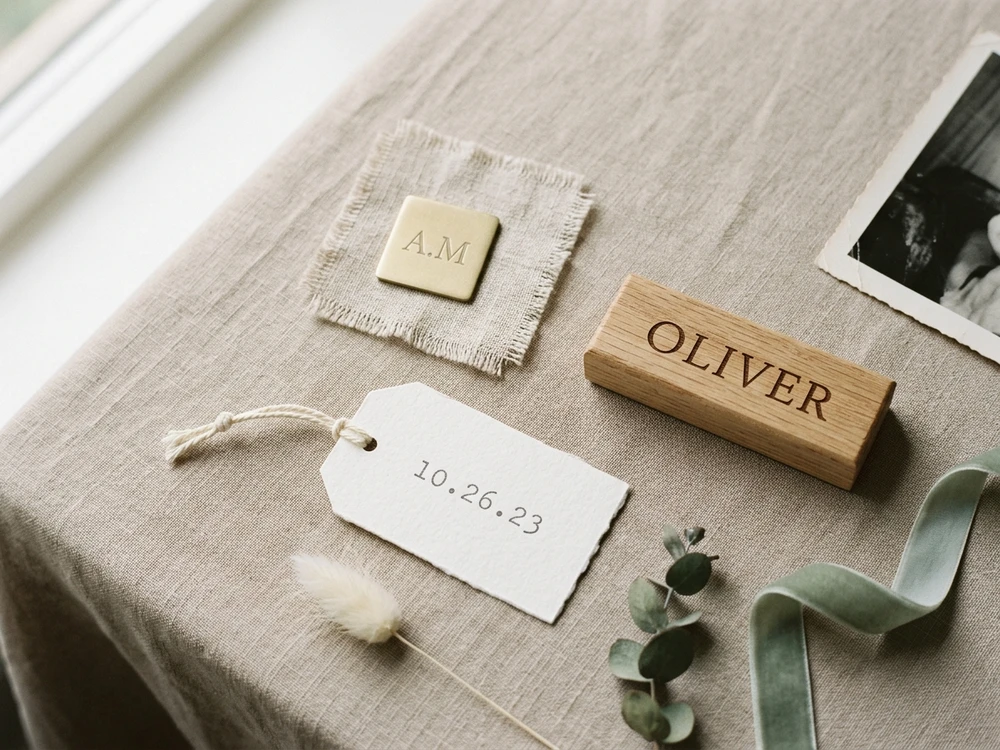
Choose initials when the meaning is already understood
Initials can work when the recipient does not need the entire story written out.
They might represent one person, a couple, siblings, or another relationship in a quiet way. Their compact form also fits the basic idea behind a small gift: the detail can remain simple while still being recognizable.
Imagine two sisters who have always signed birthday cards to each other with the same pair of initials. Using those initials on a small personalized item could carry more significance for them than a longer generic quote.
The value is not in the letters themselves. It is in what those letters already represent to the people involved.
Choose a name when recognition is the point
A name is more direct.
It can make sense when the gift is meant to recognize an individual person or their place within the family. That could be a first name, family name, nickname, or familiar form of address, depending on what genuinely reflects the relationship.
The important question is whether the wording is actually what the recipient uses.
A grandmother who has always been called “Nana” may connect more naturally with that name than with a formal title. A chosen-family member may value their own name or a shared phrase more than a conventional family-role label.
Personalization should reflect the relationship that exists rather than force it into a generic template.
Choose a date when one moment anchors the story
Dates work best when a particular day already carries significance.
A wedding, adoption, new baby, graduation, move, reunion, or another family milestone can sometimes be represented by the date alone. The recipient does not need a paragraph explaining it because they already know what happened.
Dates can also represent less public memories. Perhaps it is the day two siblings completed a long trip together or the day a family finally moved back to the same city.
The date matters because the memory matters.
If you use one, check it carefully. An incorrect date removes the specificity that was supposed to make the gift personal.
Match the personalization to the relationship
A small personalized gift should feel like it belongs to the actual relationship.
For a parent, that might be a child’s name or a familiar family phrase.
For grandparents, a grandchild’s name or a meaningful milestone may be more relevant.
For siblings, initials, a nickname, or a subtle reference to a shared memory may fit better than a sentimental message they would never normally say to each other.
For couples, a name or date can mark a shared chapter without requiring a long inscription.
For chosen families, blended families, adoptive families, or households where traditional role labels do not fit, names and personally meaningful wording may feel more natural than forcing a conventional title.
A useful test is: would this detail still make sense if nobody outside this relationship understood it?
If so, you are probably working with something genuinely specific to the people involved.
Keep a small design focused
Small-format personalization often benefits from a clear focal point.
That does not mean there is a universal character limit or that every product should be minimal. Actual layouts and personalization limits depend on the specific item and need to be checked on its current product page.
From an editorial point of view, however, one gift does not need to carry every important family detail.
Suppose you have:
- four family names;
- an anniversary date;
- a location;
- a long quote;
- and an inside joke.
All five may matter. They do not necessarily belong on the same item.
Instead, choose the element that most clearly serves the gift’s purpose.
If the anniversary is the reason for the gift, the date may be enough.
If belonging is the theme, a family name may communicate it more directly.
If the gift is between siblings, the inside joke may be the one detail no generic message could replace.
The aim is not minimalism for its own sake. It is clarity.
Small does not have to mean cheap
A small gift and an affordable gift can overlap, but they are not the same shopping decision.
A physically compact gift can fall into many price ranges depending on the actual product, materials, production method and seller. Those facts need to be checked for the item you are considering.
If your main question is “What can I buy within a particular budget?”, an affordable personalized family gift ideas guide is the more useful next step.
For the decision here, start with whether the personal detail is right.
Price is a separate filter.
Everyday reminder or milestone marker?
Another useful distinction is how the recipient is likely to relate to the gift.
Some small personalized gifts are chosen as everyday reminders of a relationship. Others exist mainly to mark a milestone.
Those are different purposes.
If your priority is frequent practical use at home, at work, or as part of a normal routine, a guide to personalized family gifts for everyday use can help you weigh those practical considerations more closely.
If the main purpose is emotional recognition, ask what the recipient should remember when they see the gift.
A milestone-oriented item might point to one important date.
An everyday family gift might use a name, initials, or another detail that remains relevant beyond one event.
Neither approach is automatically better. The right one depends on what you want the gift to represent.
Check the practical details before you order
A good idea can still be undermined by a simple ordering mistake.

Before buying a personalized family gift, check:
- The exact spelling. Do not rely on memory for an unusual spelling, surname, nickname, or family title.
- The date. Confirm the day, month and year if they are part of the design.
- What the actual product supports. Do not assume an item accepts names, dates, initials, photographs, or other customization simply because a similar product does.
- How the personalization will appear. Review the current product description, customization instructions, and any preview information the seller actually provides.
- Current processing and delivery information. Use the seller’s current information for the specific product rather than assuming a standard timeline.
- Current return or correction terms. Check the applicable policy before ordering, particularly for a customized item.
When you are ready to browse, compare matching personalized family gifts only after confirming that the product supports the name, initials, date, or other detail you want to add.
These checks are not the emotional part of gifting, but they protect the detail that makes the gift personal.
Keepsake or practical gift? That is a different question
A small personalized item can be practical, keepsake-oriented, or somewhere between the two.
If you find yourself comparing whether the recipient would rather preserve something for sentimental reasons or use it regularly, that is no longer mainly a question about size.
It is a personalized keepsake vs practical family gift decision.
Treat that as its own choice rather than trying to make one gift satisfy every possible purpose.
The clearest gifts often have one main job.
Choose the detail they will recognize
You do not need to fit the whole family story onto one object.
Choose the part that makes the recipient understand why you picked it.
That may be two initials.
One name.
One date.
One phrase that would look ordinary to everybody else.
When a small personalized family gift carries a detail that belongs to a real relationship, its physical scale stops being the important part. Recognition carries the story.
If you still need to narrow the direction, continue with the Family Gift Ideas by Budget and Use Case guide—or follow the sibling guide that matches the decision you actually need to make.