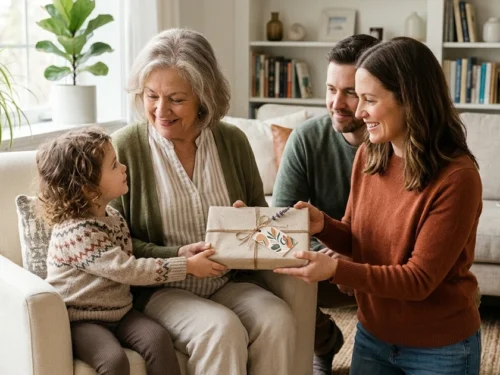


A family gift does not need to wait for a holiday, milestone or display shelf to feel meaningful. Sometimes the better choice is something that fits quietly into a routine the recipient already has.
That is the useful starting point for personalized family gifts for everyday use: do not ask “Which product should I buy?” first. Ask where the gift will live, who will use it and what part of the day it could naturally become part of.
A gift that suits the recipient’s actual life can feel personal without needing elaborate wording or a complicated design.
Start with the routine, not the product
It is easy to shop by product category. You see drinkware, apparel, home pieces, desk-oriented items or decorative gifts and try to decide which one looks best.
Reverse the process.
Picture an ordinary week for the person or family receiving the gift. Where are the repeated moments?
Maybe they start every morning in the kitchen. Perhaps they work from a desk several days a week. They might spend evenings reading on the sofa, take something with them when they leave the house, or have one shared family space where everyone naturally gathers.
Those routines give you a stronger filter than a long list of gift ideas.
routine → setting → user → personalization → product check
For example, suppose a grandparent spends a lot of time at a desk and likes having family reminders nearby. A small desk-oriented personalized item may make more sense than something designed for a shared kitchen.
If a whole household spends time together in one room, a family-oriented piece intended for a shared space may fit better than four separate gifts.
This routine-first approach also helps you avoid buying something merely because it can be personalized. The personalization should support the way the gift will be experienced.
Family gifts that fit naturally at home
Home gives you the widest range of everyday-use contexts because it includes both shared and personal routines.

Think less about “home gifts” as one category and more about what happens in different parts of the home.
A kitchen-related routine might suggest something associated with breakfast, drinks, cooking or family meals. A living-room routine may point toward something used during quiet evenings or displayed where the family spends time together. A hallway, entryway or home office creates a different kind of opportunity: the gift may be seen often even if nobody physically uses it.
The key question is not whether the object is practical or decorative. It is whether its purpose fits the place.
Shared spaces versus personal spaces
A shared family space usually calls for personalization that includes the household rather than singling out one person.
A family name, a short phrase everyone recognizes, or several names may make sense when the gift is genuinely meant for the group.
Personal spaces work differently.
A gift intended for one parent’s reading corner, one grandparent’s desk or one sibling’s room can use a more individual family role, name or message. It still celebrates family connection, but it does not have to represent the entire household.
This distinction matters especially in blended, multigenerational, chosen or other family structures where a generic surname may not represent everyone equally well. A group of first names, a shared phrase or another inclusive form of wording may fit better.
There is no rule that a “family gift” must display a traditional family name.
Choosing a personalized gift for work
Work changes the context because the recipient may use the gift around colleagues, clients or other people outside the family.

That makes personalization visibility important.
A large sentimental message that feels perfect at home may feel too private on a workplace desk. A first name, initials, family role or understated reference may be easier to live with in a semi-public setting.
The right choice depends on the person.
Someone who happily covers their workspace with family photos may enjoy visible family personalization. Someone with a minimal desk or formal workplace may prefer something subtle.
You should also distinguish between work routine and workplace assumptions.
Do not choose an item on the assumption that it is allowed, suitable or convenient in every workplace. If a product will be used around food, electronics, uniforms, shared equipment or regulated spaces, check the relevant product details and workplace requirements before ordering.
For remote or hybrid workers, “work gift” may simply mean something that belongs in a home office. In that case, you can think about both sides of the recipient’s routine: does the gift help the space feel more personal, or does it have a practical role during the working day?
Both can work. The recipient’s habits should decide.
Think beyond home and work
Not every everyday routine happens in a fixed room.

Some family members spend much of their day moving between places. Others have hobbies, errands or recurring activities that matter more to them than their desk or living room.
That is where portable or routine-connected gifts become worth considering.
Think about the moments that repeat.
A relative may always take something along when leaving the house. A parent may have a weekend routine built around a hobby. Grandparents may meet family regularly for an activity outside the home. A couple might have a small ritual they repeat every week.
The gift does not need to announce the routine literally. It only needs to fit into it.
This is also a useful way to avoid forcing a “family” design onto an item that the recipient already uses for another purpose. Sometimes a first name, nickname, family role or subtle shared reference is enough to make the object personal while preserving its everyday usefulness.
Decide how visible the personalization should be
The personalization itself changes how easy a gift is to use every day.
Before choosing wording, ask who will normally see it.
More public setting: keep the personalization relatively simple if that suits the recipient. A name, initials or familiar family role can be enough.
Private home setting: you have more room for a personal phrase, an inside reference or several family names.
Shared household setting: consider wording that includes the people who will actually use or see the gift rather than defaulting automatically to one recipient.
The best wording is not necessarily the most detailed wording.
If the gift already has strong personal meaning because of where it will be used, a small amount of customization may be more effective than filling every available space.
For example, “Nana” may carry more emotional meaning in one family than a full paragraph ever could. In another family, a surname may feel natural. A chosen family might prefer a phrase that represents their connection rather than a legal or shared family name.
Use the language the family actually uses.
Match the gift to one person or the whole household
“Family gift” can describe two different things.
One is a gift for a family member.
The other is a gift for the family as a group.
Those are different shopping decisions.
If one person will use the gift, prioritize that person’s habits, tastes and environment. The family connection can come through the personalization.
If several people will share it, think about whether the object genuinely fits a shared routine. A household gift is more convincing when it belongs to something people already do together.
Do not assume that including more names automatically makes a gift better.
A long list of names may be meaningful on one design but visually crowded on another. Depending on the family and the design, a shared phrase, role or surname may create a clearer result.
The product’s actual personalization options should determine what is possible. Check them rather than assuming a particular number of names or amount of text will fit.
Useful does not have to mean impersonal
A common tension in gift shopping is the feeling that practical gifts are less emotional than keepsakes.
For everyday family gifts, that does not have to be true.
The emotional meaning can come from the connection between the personalization and the routine.
A familiar family role seen during an ordinary morning can matter because it is familiar. A shared phrase in a space the family uses every day can feel personal because it belongs there.
You do not have to turn the gift into a memorial of every important family moment.
Often, one accurate detail is enough.
If your real decision is whether the recipient would prefer something deliberately sentimental or something primarily useful, that question deserves its own comparison. Keepsake or Practical Gift: Which Family Gift Should You Choose? is the better next step for that decision.
Check the practical details before you order
Once the routine and personalization are clear, evaluate the actual product.
This is where imagination should stop and verification should begin.
Check the current product description for the details that matter to the intended use. Depending on the item, that could include dimensions, material, care requirements, included components, sizing or supported personalization.
If the gift will be used at work, carried frequently or placed in a particular part of the home, check whether the specifications fit that situation.
Also review the personalization carefully.
Look at spelling, family roles, punctuation, dates and name order. If a preview or mockup is available on the specific product, check what it actually shows rather than assuming every detail will appear exactly as imagined.
Shipping, processing, returns, changes and cancellation rules can vary as well. Verify the current information that applies to the actual item and destination before ordering, particularly when the gift is needed by a particular date.
A personalized gift becomes much easier to choose once the emotional decision and the practical verification are treated as two separate steps.
When another gift guide will help more
Everyday use is only one way to narrow a family gift.
If your main constraint is cost, move to a budget-led guide rather than letting price take over this article’s routine-first decision process. Affordable Personalized Family Gift Ideas is the more relevant direction.
If you specifically want something physically modest that still carries emotional weight, Small Personalized Family Gifts with a Big Emotional Meaning addresses that narrower need.
And if you are stuck between an object chosen mainly for regular use and one chosen primarily to preserve a memory, the keepsake-versus-practical comparison is the better place to make that trade-off.
Using the right question makes gift shopping much simpler.
Choose the routine first, then the gift
A personalized family gift for everyday use works best when it fits into a life that already exists.
Start with an ordinary day.
Notice where the recipient spends time, what they repeatedly use or see, whether the gift is personal or shared, and how public the personalization will be. Then choose wording that reflects the family naturally and verify that the actual product suits the intended use.
You do not need the most elaborate customization or the most unusual object. You need a gift that makes sense in the recipient’s routine and carries a detail that makes it recognizably theirs.
When you are ready to compare different directions, explore family gift ideas by budget and use case and narrow the options around the way the family actually lives.