A personalized family gift can feel wonderfully specific—but adding a name, date or message does not automatically make a present more thoughtful. Sometimes the better gift is a well-chosen item with no customization at all.
The useful question is not “Are personalized gifts better?” It is “Will personalization make this particular gift fit this particular person better?”
That distinction matters. Gift-giving research has found recurring differences between what givers expect recipients to appreciate and what recipients actually prefer. A 2024 meta-analysis examined 153 effects from 114 studies and found that the size of giver–recipient mismatches varies with characteristics of the gift, occasion and people involved.
So rather than assuming one category wins, compare personalized and generic gifts on fit, relevance, flexibility and how confidently you understand the recipient.
The Short Answer: Choose for Fit, Not for the Label
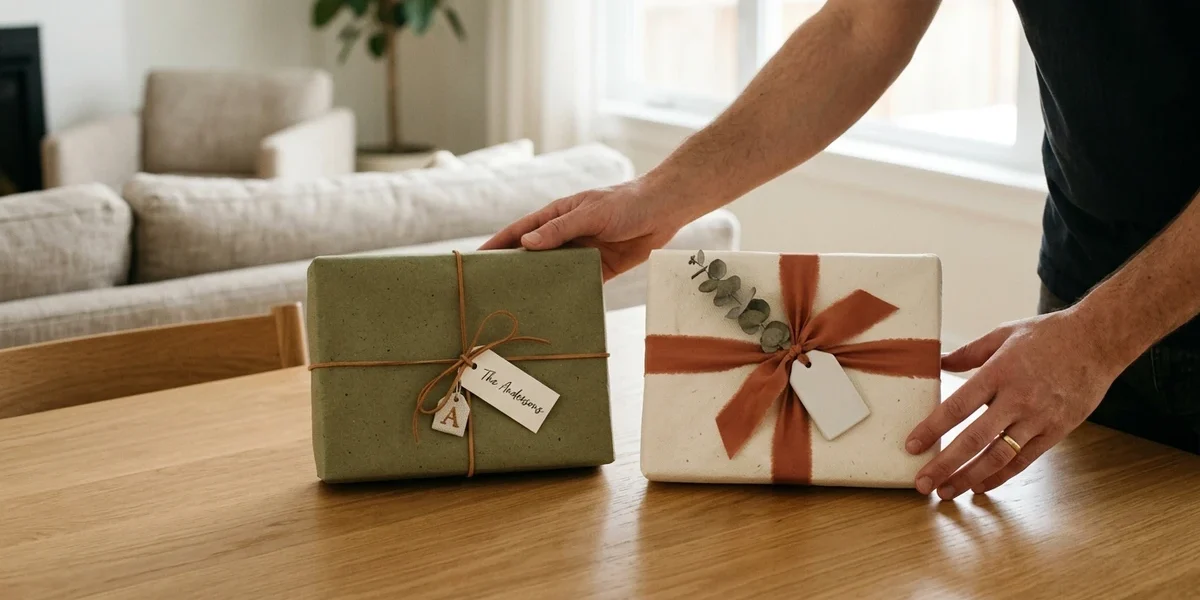
Choose a personalized family gift when you have a detail that genuinely belongs to the recipient: a name they use, an important date, a family role, a shared phrase or another element that carries real meaning.
Choose a generic gift when you are less certain about personal details, when the recipient prefers understated items, or when flexibility is more valuable than specificity.
Neither choice is inherently more thoughtful.
A generic gift chosen around someone’s actual interests can feel far more personal than a customized item that simply has their name added to it. Likewise, a carefully chosen personalized gift can express a family connection in a way a non-personalized alternative cannot.
The underlying gift still has to make sense.
Personalized vs Generic Family Gifts at a Glance
| Decision factor | Personalized family gift | Generic family gift |
|---|---|---|
| Personal specificity | Can include details tied to the recipient or family | Usually suits a broader range of people |
| Recipient knowledge needed | Often higher | Can be lower |
| Flexibility | More specific to one person or household | Often easier to choose when tastes or details are uncertain |
| Sensitivity to errors | Names, dates and wording need careful checking | Fewer personal details need to be correct |
| Sentimental potential | Can directly reference relationships or memories | Can still feel thoughtful through careful selection |
| Decision effort | May involve choosing and checking customization | Usually involves fewer customization decisions |
| Best fit | When a meaningful personal detail clearly adds something | When usefulness, flexibility or uncertainty matters more |
This is not a scorecard. A personalized gift does not “win” every row, and a generic gift does not automatically sacrifice emotional value.
The right side of the table depends on the recipient.
When Personalization Adds Something Meaningful
Research into gift personalization suggests that recipients can value both the utility of the item and what the customization communicates about the giver. Recipients in one qualitative study also valued the thought and process they associated with creating the personalized gift.
That does not mean every custom gift carries the same value. Personalization is most useful when the detail itself has a reason to be there.
You know exactly which detail matters
Suppose your sister always signs family messages with the same playful phrase. Putting that phrase on an appropriate gift may feel specific because it reflects something real about your relationship.
That is different from choosing a random quotation simply because a design provides space for custom text.
The same principle applies to names. A family name, children’s names, a grandparent title or a meaningful date can add relevance when you know those are details the recipient values.
If you are guessing, the advantage becomes less clear.
The gift marks a family-specific moment
Personalization can make particular sense when the occasion itself is tied to identity or memory.
For example, a new household name, anniversary date, new family member or established family tradition may give you an obvious detail to work with.
The important part is the connection between the detail and the moment—not simply the presence of custom text.
Research on sentimental gifts offers a useful reminder. In three studies, givers selected sentimentally valuable gifts less often than recipients would have preferred, partly because givers felt less certain those gifts would be liked.
That does not mean “always choose sentimental.” It means uncertainty alone should not automatically push you toward the safest-looking option when you genuinely understand what matters to the recipient.
The recipient actually likes personalized items
Some people enjoy seeing a family name, children’s names, pet names or a familiar family phrase represented in their home or everyday belongings.
Others prefer simple designs with little or no visible personal information.
Both preferences are reasonable.
Personalization is strongest when it reflects the recipient rather than the giver’s assumption that a custom item must feel more meaningful.
When a Generic Gift Can Be the Better Choice
The word “generic” can sound dismissive, but a non-personalized gift is not automatically a careless gift.
Sometimes it is the choice that respects the recipient best.
You are unsure about the details
If you are not sure how someone spells a name, which surname they use, whether a family title feels right, or whether they want a personal message displayed, adding customization creates unnecessary uncertainty.
You do not have to turn that uncertainty into a guess.
A flexible gift based on something you do know—such as how they spend their time, what they enjoy using or what suits the occasion—may be more considerate.
Flexibility matters more than specificity
Personalized gifts are deliberately specific. That can be their strength, but it can also reduce flexibility.
Imagine you are buying for relatives who are moving house and have not yet decided how they want the new space to look. A highly specific decorative design may be harder to place than a broadly useful gift chosen around their known habits.
Or imagine buying for a family member whose tastes change often. A versatile item may have more everyday value than something customized around a temporary preference.
The question is not whether customization sounds more impressive. It is which gift better fits the recipient’s life.
Personalization would feel forced
A useful test is simple:
If you removed the name or message, would you still think this was a good gift for the recipient?
If the answer is no, the customization may be doing too much work.
Start with an item or idea that already fits the person. Then ask whether a personal detail genuinely improves it.
If you are adding text merely because customization is available, leaving the gift unpersonalized may produce a more natural result.
A Generic Gift Can Still Feel Personal
Personalization and personal relevance are not the same thing.
You might give your brother a non-customized item connected to a hobby he talks about constantly. You might choose something for your parents because it solves a small everyday problem they mentioned months ago. You might choose a gift for a close friend or chosen family member in a style you know they prefer.
None of those gifts needs a printed name to demonstrate attention.
Research across many gift-giving studies has documented persistent differences between giver and recipient evaluations, which is another reason to focus on the recipient rather than on what merely looks gift-worthy to the giver.
A useful question is:
Am I choosing this because it expresses my idea of a thoughtful gift, or because it actually fits the person receiving it?
That question helps with both personalized and generic options.
Watch the Cost of Getting Personalization Wrong
The more specific a gift becomes, the more important the details become.

A generic item may leave more room for uncertainty. Personalized wording usually leaves less: names, dates, family roles and messages need to reflect what the recipient actually uses and values.
Even a technically correct name may not be the name someone prefers to see on a gift.
This does not make personalization inherently risky. It simply changes the kind of confidence you need before ordering.
If several family members will appear in a design, the next question may become how many names should go on the family gift rather than whether personalization is worthwhile at all. That detailed member-list decision belongs in a separate guide.
Once you have settled the wording, a final pre-order check for spelling and other order details becomes more useful than continuing to debate personalized versus generic.
A Simple Way to Decide
You do not need a complicated scoring system. Ask four questions.
1. Do I know the recipient well enough?
If you understand their tastes and know which personal details matter to them, personalization becomes easier to justify.
If you are guessing, favour flexibility.
2. Does the personal detail add meaning?
A family name connected to a new home may have a clear purpose. A date connected to an anniversary may have one too.
A random message added only to fill a customization field does not automatically improve the gift.
3. Would they want that detail visible?
Some recipients enjoy names and family references on display. Others prefer privacy or more understated design.
Think about their taste, not just the customization possibilities.
4. Is the underlying gift still a good fit?
Personalization should strengthen a good idea rather than rescue a weak one.
If the recipient would not use, display or enjoy the basic gift, adding their name is unlikely to solve the mismatch.
The decision can be reduced to one principle:
Personalize when you know what makes the gift specifically theirs. Stay generic when flexibility is more thoughtful than specificity.
If You Choose Personalized, Decide What Comes Next
If you choose a personalized family gift, the next decisions become more practical.
First, choose the right format. A mug, sweatshirt and piece of wall art serve different routines and spaces, so the best format depends on how the recipient is likely to use the gift. The separate guide to choosing among those family gift formats can help with that next step.
Then decide which people or details belong in the design. If several relatives are involved, use the dedicated guidance on how many names to include rather than assuming every possible name has to appear.
Finally, review the order details carefully before buying. A family gift buying checklist can help you move from the emotional decision—yes, this should be personalized—to the practical one—is everything ready to order?
Personalized and generic gifts can both be thoughtful. The stronger choice is the one that reflects what you genuinely know about the recipient rather than what a product label seems to promise.
If you are still comparing directions, start with family gift comparisons and shortlists. For broader inspiration across recipients and occasions, explore family gift ideas before deciding how much personalization belongs in the gift.