
There is no ideal number of names that works for every family gift.
The better question is: Who does this gift represent?
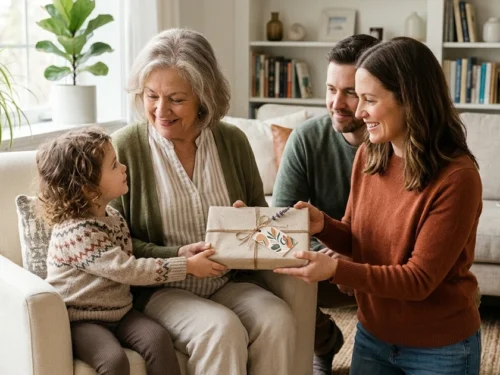
If the gift is meant to celebrate an entire household, leaving one household member off may feel strange. If it marks a relationship between a grandparent and three grandchildren, those three names may be exactly enough. And if it celebrates one couple, adding every relative simply because there is space can make the idea less focused.
Choose the people first. Check what the specific product supports second.
Start with what the gift is meant to represent
Before writing down names, finish this sentence:
“This gift is about…”
Your answer defines the natural boundary.
It might be about:
- everyone living in one home;
- a grandparent and their grandchildren;
- siblings who share a particular memory;
- a couple building a home together;
- one side or generation of a larger family;
- a chosen-family group;
- the people and pets who make up a household.
These are different stories, so they do not need the same number of names.
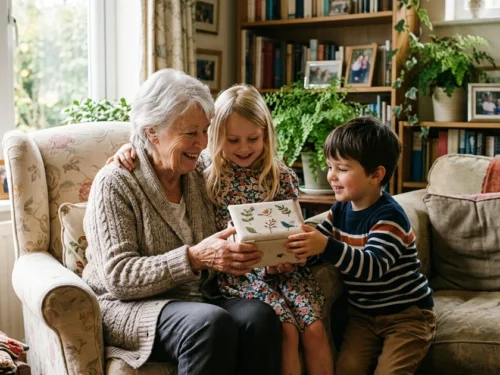
A gift for Grandma from her grandchildren, for example, does not automatically need the names of Grandma, Grandpa, every adult child and every other relative. If the meaning is specifically the bond between Grandma and her grandchildren, the grandchildren may be the relevant list.
That is more useful than trying to find an arbitrary number that supposedly looks “best.”
Use one simple rule for deciding who to include
A practical rule is:
Include every person whose absence would make the gift tell a different story.
That does not mean every personalized family gift needs every member of the extended family.
It means the names should match the promise the design makes.
If the wording says “Our Family,” a selective list may imply that the listed people define that family. If the wording is “Grandma’s Grandkids,” the boundary is already much clearer.
The more specific the idea, the easier the name decision becomes.
When including everyone makes sense
Including everyone is usually the natural choice when the gift is explicitly about a complete group.
That might be a shared household, all the children in one immediate family, all the grandchildren in a particular grandparent gift, or every sibling in a sibling keepsake.
In those situations, an unexplained omission can attract more attention than the names you did include.
This is especially worth checking when several people occupy the same role. Listing four grandchildren while leaving out a fifth, for instance, communicates something whether you intend it to or not.
When a smaller group makes more sense
A narrower list can be completely appropriate when the gift celebrates a narrower relationship.
A parent-and-child keepsake does not need every sibling.
An anniversary gift for a couple does not need the wider family.
A birthday gift based on one shared memory might name only the people involved in that memory.
The goal is not maximum inclusion. It is accurate inclusion.
Check for unintended omissions
Once you have your first draft of the name list, look at it from the recipient’s perspective.
Ask:
If they saw these names with no explanation, what would they think this group represents?
That question catches problems that a simple headcount misses.
For example, imagine a household with two parents, three children and a dog everyone treats as part of the family. If the gift is a household portrait, the dog may feel like an obvious part of the idea. On a more formal gift celebrating the parents’ wedding anniversary, the pet may be irrelevant.
Neither choice is universally correct.
What matters is whether the list makes sense for this recipient, this relationship and this particular gift.
The same principle helps with blended families, chosen families and families where grandparents or other relatives are primary caregivers. Start with the relationships people actually use and value rather than trying to force the design into a generic family template.
Individual names are not your only option
Sometimes the answer to “How many names?” is that a full list is not the best personalization choice at all.
A long member list can sometimes be replaced with something that represents the group more naturally, such as:
- a family surname;
- a household name;
- “The Smith Family” style wording;
- a meaningful family role;
- a short shared phrase;
- a date or place connected to the family story.
This can be useful for a large or changing family, but it should not be treated as a trick for bypassing a product limit.
First decide what wording best expresses the idea. Then find a design that supports it.
If your main question has become how many names physically fit on a personalized family gift, that is a separate design-and-capacity decision. The answer depends on the actual product rather than a universal family-gifting rule.
Think about how the family may change
Personalized gifts often capture one moment in time, and there is nothing wrong with that.
A gift celebrating the family as it exists this Christmas, at a reunion or after a new baby arrives does not have to predict every future change.
But it is worth thinking about longevity when the design makes a broad, permanent-sounding statement.
If the family is likely to grow soon, ask whether the gift is meant to document this moment or represent the family for many years.
Those are different purposes.
For a moment-specific keepsake, individual names can help document exactly who was part of that chapter.
For a gift intended to represent an evolving household for a long time, a surname or shared phrase may sometimes age more naturally.
Again, there is no universal rule. The choice follows the purpose.
Decide the people first, then check the product
Do not let an assumed personalization limit decide who matters.
Make your intended member list first.
Then check the current product description or personalization fields to see whether that specific design supports what you want to add.
Different personalized products can have different personalization rules, so a number that works for one design should not be treated as a rule for another.
If your preferred gift cannot support the list you genuinely want, you have a few choices:
- use a shared family name or phrase if that still expresses the same idea;
- choose a format better suited to the intended personalization;
- narrow the list only if doing so still tells the right story.
Once you know who belongs on the gift, the broader family gift comparison and shortlist guide can help you narrow the kind of gift before you move into product-specific checks.
If the real decision is now about the product format itself, a guide to choosing the right family gift format can help you compare your options without changing the meaning you want the gift to carry.
A few practical examples
Here is how the same framework can lead to different answers.
| Situation | Natural starting point |
|---|---|
| Gift for grandparents from their grandchildren | The grandchildren connected to the gift |
| Household gift for a family home | The people the household itself considers part of that group |
| Sibling keepsake | The siblings involved in the relationship |
| Couple gift | Usually the couple rather than the entire extended family |
| Chosen-family gift | The people who genuinely make up that chosen-family circle |
| Gift based on one shared memory | The people directly connected to that memory |
These are examples, not rules.
A family can define itself differently from another family in an apparently similar situation. Use the gift’s meaning—not a preset family structure—to make the final call.
What if the list still feels too long?
If you keep adding names because you are worried that leaving anyone out will cause hurt, return to the sentence from the beginning:
“This gift is about…”
If you cannot finish that sentence clearly, the problem may not be the number of names. The concept itself may be too broad.
A focused gift usually has a natural inclusion boundary.
Once that boundary is clear, the member list becomes much easier to defend.
If you know exactly who belongs but are unsure whether a design can handle that list, keep the names and move the question into the product-selection stage. That is where actual personalization capacity, placement and readability belong.
Should pets be included on a family gift?
Include a pet when the pet genuinely belongs to the family story the gift is trying to represent and the chosen design supports that personalization.
Do not add pets automatically just because the product allows it. And do not assume they should be excluded simply because the other names are human family members.
The same inclusion rule still works: would leaving the pet out make the gift feel like it is describing a different household or relationship?
Do you have to include every child or grandchild?
Not in every gift.
If the gift claims to represent all the children or grandchildren, leaving someone out may create an unintended message.
But a gift tied to one specific child, one branch of the family or one shared event can use a narrower list without implying that other relatives matter less.
Make the wording and the name list tell the same story.
What should you do before ordering?
Once you have settled on the member list, stop editing the family story and switch to order checking.
Confirm that the chosen product supports the personalization you want, then review the names exactly as entered and check any available product-specific instructions.
A family gift buying checklist before you order is the better place to handle spelling, preview, delivery and other final purchase checks in detail.
The most meaningful list is not the shortest one or the longest one. It is the one that makes the recipient immediately understand who—and what—the gift is celebrating.
Decide that first. Then choose a personalized family gift that can support the idea without forcing you to change it.