
A family gift feels personal when the recipient can understand why you chose it for them.
That can matter more than how many names, dates or custom details you can fit into the design.
Instead of beginning with “What can I personalize?”, start with a better question:
What part of our relationship do I want this gift to represent?
It might be a family role someone is proud of, a place everyone associates with home, a milestone, a running joke, a shared hobby or a small memory that would mean very little to anyone outside the family.
Once that part is clear, choosing the actual gift becomes much easier.
Start With the Meaning, Not the Customization
Personalization works best when it has a reason to be there.
Adding a surname can make sense when the gift celebrates a household or new home. A date can carry real weight when it marks an anniversary, adoption, wedding or another meaningful chapter. A short phrase may work better when the relationship is built around humour, encouragement or something the family always says.
But none of those details is automatically meaningful on its own.
Imagine you are choosing between two gifts for a grandparent. One can fit every grandchild’s name. The other connects to a weekly tradition the family shares.
The first has more customization. The second may feel more personal if that tradition is what the grandparent treasures most.
The useful distinction is simple:
Customization describes what can be changed. Personal meaning explains why that change belongs in the gift.
If you are still deciding which memory, name or milestone should inspire the gift, the broader guide to meaningful family gift ideas for names, memories and milestones is a useful place to explore those directions before narrowing your choice.
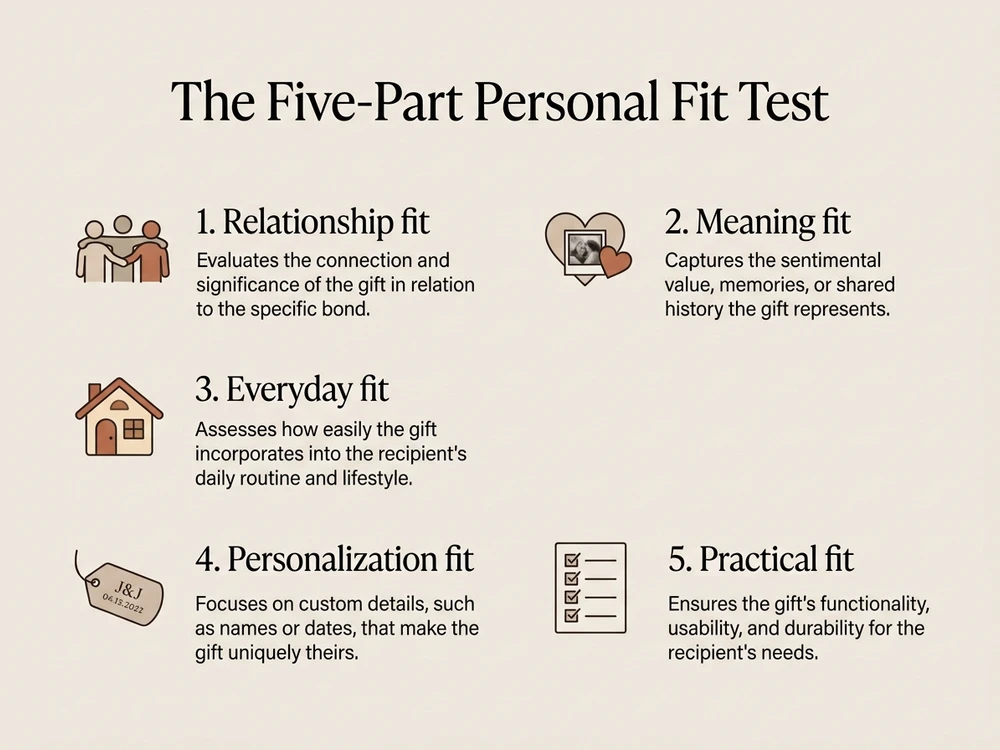
Use the Five-Part Personal Fit Test
When several personalized gift ideas seem possible, test each one against five questions.
1. Does it fit the relationship?
Begin with who the gift is really for.
A gift for one parent can speak directly to that person’s role or personality. A gift for grandparents may represent several generations. A gift for a couple might focus on something the two people share. A whole-family gift needs to feel inclusive enough that it does not turn one person’s taste into everybody’s gift.
The goal is not to force every family member into the design. It is to understand the relationship the gift is meant to celebrate.
Ask:
If the personalization disappeared, would the basic gift still make sense for these people?
If the answer is no, you may be relying on customization to rescue a weak match.
2. Does the personal detail mean something?
Next, look at the detail you plan to add.
A strong personal detail has a story behind it.
That could be:
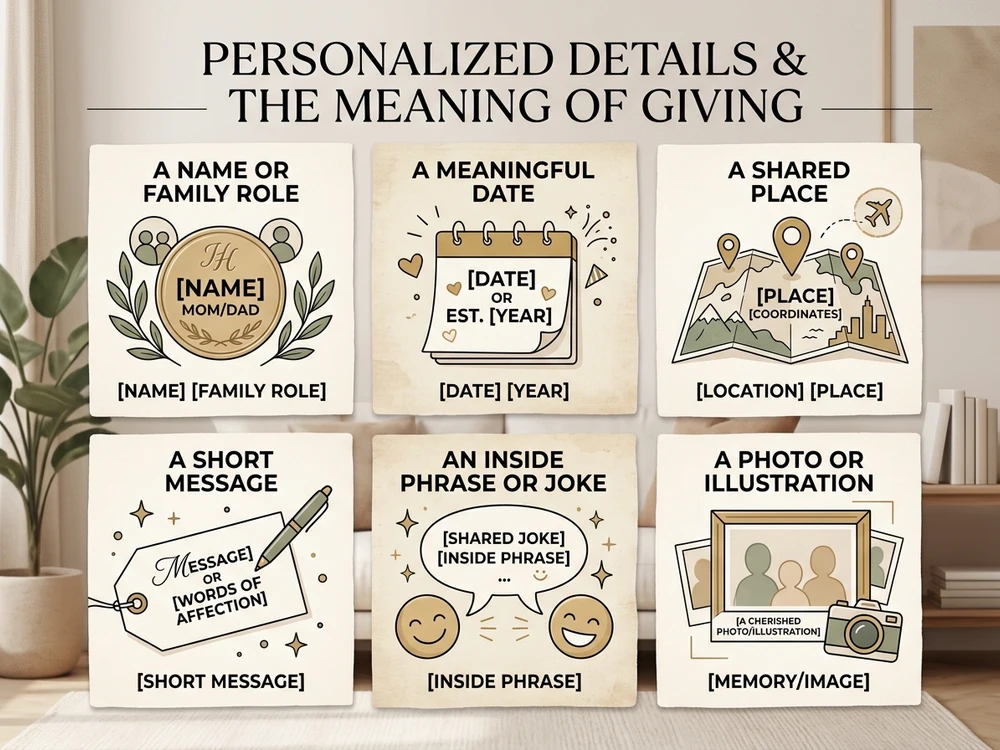
- a name or family role;
- an important date;
- a location with shared meaning;
- a short family saying;
- a shared hobby;
- an inside joke;
- a photograph;
- a reference to a meaningful chapter or tradition.
You do not need several at once.
One well-chosen detail can communicate more clearly than a design crowded with every possible name, date and phrase.
A useful test is to finish this sentence:
“I chose this detail because…”
If the answer comes easily, you probably have a meaningful connection. If the best explanation is simply “because the website lets me add it,” keep looking.
3. Does the gift fit their everyday life?
A thoughtful idea can still be the wrong gift format.
Consider what the recipient naturally uses, wears, keeps or displays.
Someone who prefers an uncluttered home may not want a large decorative piece, however sentimental the message. A relative who rarely wears matching or slogan-based clothing may not become enthusiastic about it just because it has a family reference.
On the other hand, a familiar everyday object can become more personal when the customization connects naturally to the person’s routine.
Before choosing, ask:
- Would they use this?
- Would they wear it?
- Would they display it?
- Would they prefer to keep the personal message private?
- Does the style feel like them, or like me?
This is where personal knowledge matters more than trends.
If your real goal is to celebrate the small routines and ordinary connections that make family life special, thoughtful family gifts that celebrate everyday moments is a more focused direction to explore.
4. Is the type of personalization right?
Once the gift itself fits, decide how visible or detailed the personalization should be.
Personal does not have to mean elaborate.
A subtle date can carry more significance than a long message. A nickname may feel warmer than a formal name. A shared phrase may make more sense than a generic family quote.
Different details communicate different things.
| Personal detail | What it can communicate |
|---|---|
| Name or family role | Identity, belonging or recognition |
| Date | A specific milestone or chapter |
| Place | Home, travel or a shared origin |
| Short message | Appreciation or encouragement |
| Inside phrase or joke | Shared history and familiarity |
| Photo or illustration | A visual memory or representation |
Availability varies by product, so check the current product page before building your idea around a particular option.
5. Does it work in practice?
A personal gift still has to survive the ordinary details of ordering.
Before buying, check the actual product information rather than assuming one personalized item works like another.
Depending on the product, useful things to verify may include:
- which fields can actually be personalized;
- spelling and punctuation;
- the order in which names appear;
- size or dimensions;
- available design choices;
- care information;
- processing and delivery information;
- current return or correction rules.
For an occasion with a fixed date, practical fit matters even more. A meaningful idea is not helped by relying on an unverified delivery assumption.
For any product you are considering, check the current product or policy page for personalization, shipping and return details before you order.
Choose Personalization for What It Communicates
Once you know what the gift should represent, the right personalization becomes easier to choose.
Names and roles work when identity is the point
Names can make sense when you want to acknowledge who belongs to a family, household or relationship.
Roles can be equally meaningful when the role itself matters—grandparent, sibling, caregiver, partner or another way someone understands their place in the family.
That can also include chosen family. A personal gift does not need to follow one traditional family structure to communicate belonging.
Dates work best when the date has a story
A date can be powerful when the recipient instantly knows why it matters.
An anniversary, wedding, adoption, graduation, new-home date or another genuine milestone may carry meaning. A date added simply because the layout has space for one usually carries less.
The question is not “Can I include a date?”
It is “Will this date bring something specific to mind?”
Messages should sound like the relationship
A generic sentimental quote can be attractive. A phrase that actually sounds like the people involved can feel much more personal.
Think about how your family talks to one another.
Would a formal message feel natural? Would something playful fit better? Is there a phrase people repeat often enough that it immediately feels familiar?
The strongest wording often sounds like the relationship rather than like a greeting card.
Photos or illustrations should earn their place
Where a product supports them, photos or illustrations can create a strong connection to people, pets or shared memories.
But visual personalization deserves the same test as text: does this image represent something the recipient would genuinely want to see again?
A favourite photograph may be a better choice than the technically “best” image. An illustration of household members or pets may work when the idea is family identity rather than a specific event.
Use only images you have the right and permission to use, and avoid placing unnecessarily private information in designs that may be displayed publicly.
Match the Gift to Real Family Life
One of the easiest mistakes in gift giving is choosing for an imagined version of the recipient.
Perhaps the design looks beautiful in a product photo, but it does not fit their home. Maybe matching items look fun online, but the family members would never wear them. Perhaps a large, highly sentimental message suits the giver better than the recipient.

Try picturing the gift six months after it is opened.
Where is it?
If you can easily imagine it being used, worn, displayed or kept somewhere meaningful, that is a useful sign.
If you cannot picture what happens after the unwrapping, pause before adding more personalization.
Sometimes the most personal decision is not adding another custom detail. It is choosing something that fits naturally into the life the family already has.
Know When Less Personalization Is Better
More customization means more details to verify, and it can also make a design busier or reveal more information than the gift needs.
A long list of family members may later need updating. A private joke may feel awkward on something displayed in a shared space. A full address, sensitive personal information or an intensely private message may not belong on an item other people can easily see.
There is also the design itself.
If several elements are competing for attention, the detail that actually matters can disappear.
When in doubt, decide what the gift needs to say in one sentence and remove anything that does not help say it.
For example:
“This celebrates the home they have created together.”
That might need only a family name or a meaningful phrase.
Or:
“This reminds her of the summers we all spent together.”
That may point toward a place, date, image or family saying.
Personalization is strongest when every detail has a clear reason to be there.
Check the Practical Details Before You Order
Before completing an order, separate the emotional decision from the factual checks.
First, confirm that you still like the idea.
Then review the details with fresh eyes.
Check:
- every name;
- every date;
- spelling and punctuation;
- whether nicknames or formal names are correct;
- whether everyone who should be represented is included;
- whether any detail is more private than it needs to be.
Then check the seller’s current product and policy information.
Do not assume materials, sizes, personalization limits, delivery timing, care instructions, preview features or return rules from another personalized product.
If a personalized gift is intended for a birthday, Christmas, anniversary or another fixed occasion, verify the current ordering information before relying on it.
That final practical check is part of choosing thoughtfully, not an administrative afterthought.
A Final Personal-Gift Checklist
Before you decide, ask yourself:
- Who is this really for?
- What part of our relationship am I trying to represent?
- Why does the chosen name, date, message, image or other detail matter?
- Would the gift itself suit the recipient even without personalization?
- Will they realistically use, wear, display or keep it?
- Is the personalization appropriate for how public or private the item will be?
- Have I checked every custom detail carefully?
- Have I verified the current product, delivery and return information rather than assuming it?
If you can answer those questions clearly, you probably do not need to keep searching for something “more personal.”
You need the option that tells the right story in the simplest way.
For broader inspiration, explore Meaningful Family Gift Ideas, then use this framework to narrow the possibilities to the one that feels most connected to the people you are celebrating.
If you are ready to explore products, keep the meaning you chose at the centre of the decision. Compare the personalization options and current ordering details on each product page, and choose the one that fits both the relationship and the recipient’s real life.