
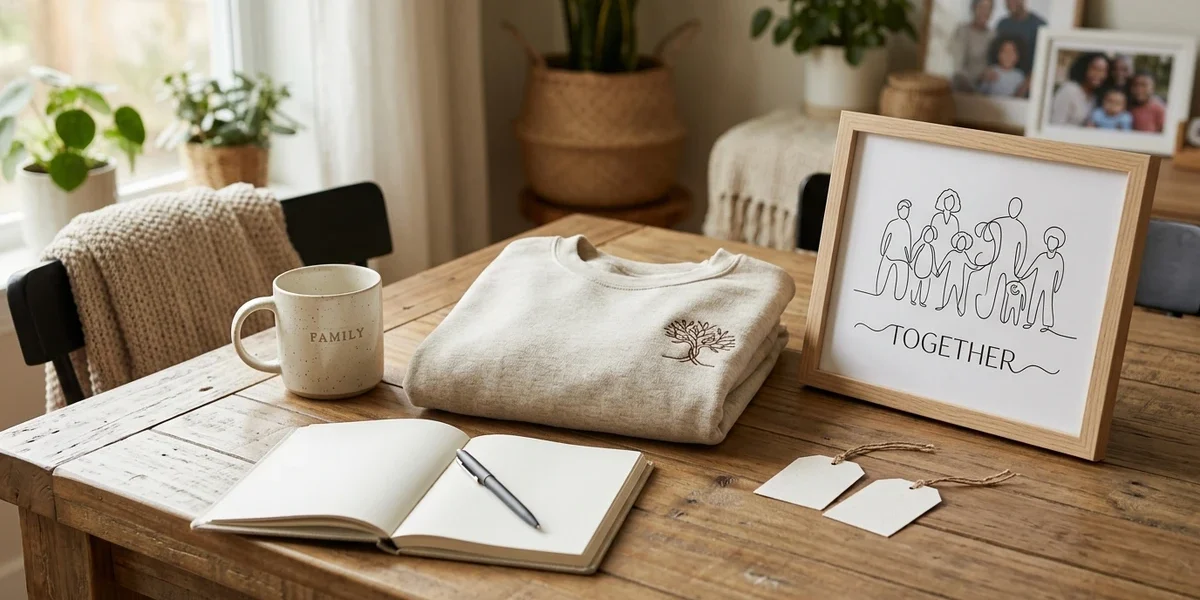
A long list of family gift ideas can make choosing harder, not easier. A mug, sweatshirt, piece of wall art and personalized keepsake may all sound thoughtful, but they serve different purposes. Comparing them only by which one looks nicest on a shopping page does not tell you which one fits the people receiving it.
A better approach is to decide what the gift needs to do, then compare every option against the same criteria.
Within the broader Family Gift Discovery & Ideas hub, this guide focuses on one part of the decision: turning several plausible gift directions into a manageable shortlist.
That might mean finding something one person can use regularly, something a household can display together, or something that captures a name, date, message or shared memory. Once you know the role of the gift, a long list becomes much easier to narrow.
Start with the job the gift needs to do
Before comparing individual products, finish this sentence:
I want this gift to…
- become part of the recipient’s everyday routine;
- represent several family members together;
- mark a milestone or important date;
- bring a shared memory into the home;
- give one person something that feels specifically theirs;
- celebrate a family identity, phrase or relationship;
- simply be useful while still feeling personal.
This first decision matters because two good gifts can still solve completely different problems.
For example, something intended for regular use should be evaluated differently from something chosen mainly for display. A gift for one grandparent may need different personalization from a gift intended to represent an entire household.
If your bigger question is still what makes a family gift meaningful in the first place, the Meaningful Family Gift Ideas Cluster is the better starting point. This guide assumes you already have several plausible directions and need to compare them.
Compare every option using the same criteria
Once you have a few ideas, avoid changing your standards every time you see something new.
Use the same five questions for every candidate.

1. Does it fit the recipient?
Start with the people, not the product.
Consider what the recipient actually enjoys, uses, displays or talks about. Think about the family relationship the gift is meant to recognise as well.
A present for parents from their children, for example, may carry a different message from one exchanged between siblings or given to a couple for a new home.
You do not need to force every family member onto every gift. The better question is whether the final idea reflects the people the gift is genuinely about.
If the relationship itself is the main thing making the choice difficult, move to Family Gift Ideas for Relationships rather than trying to solve every recipient scenario here.
2. Does the format fit how the gift will live?
Imagine the gift a month after it has been opened.
Where is it?
Is it being worn? Used during a normal routine? Displayed in a shared room? Brought out for a particular season? Kept mainly as a reminder of an important moment?
This is often more useful than asking which product type is “best.”
A practical format may suit someone who prefers things they can use. A display-oriented format may make more sense when the design or family message is the main attraction. Wearable gifts introduce another question: whether the recipient would genuinely enjoy wearing the design.
If your shortlist has reached the point where you are directly weighing formats such as a mug, sweatshirt and wall art, that comparison deserves its own deeper decision. See Mug, Sweatshirt or Wall Art: Which Family Gift Fits Best?
3. Does personalization add something meaningful?
Personalization should have a reason to be there.
A name can identify the recipient. Several names can represent a family group. A date can mark a milestone. A short message can preserve wording that matters to the people involved.
But adding custom details does not automatically make an idea better.
Ask what would be lost if the personalized element disappeared. If the answer is “not much,” the customization may be decorative rather than central to the idea. That can still be fine, but it should not distract you from whether the gift itself is a good fit.
If you are genuinely undecided between a customized option and a non-customized one, continue with Personalized Family Gifts vs Generic Family Gifts.
4. Does it match the occasion without depending on it?
Some gifts are closely connected to an event. Others can work well without an occasion at all.
A milestone may make a date especially important. A family reunion may make shared names, a family phrase or a location more relevant. Everyday appreciation may call for something simpler and easier to integrate into normal life.
The occasion should help you filter ideas, not force unnecessary decoration onto them.
If the gift would stop making sense the moment the event passed, ask whether that is intentional. A highly occasion-specific item can be exactly right when the point is to remember that moment. For another recipient, a more evergreen choice may have more relevance afterward.
5. Can you order it with confidence?
A promising idea is not yet a ready-to-order gift.
Before it reaches your final shortlist, confirm that you understand the actual product page for the item you are considering.
Depending on the product, relevant checks may include the available personalization fields, the wording you plan to enter, the chosen variant and any current ordering or delivery information provided by the seller.
Do not assume that one personalized product works like another. Customization options, order processes and policies can differ.
When you are close to checkout, use A Family Gift Buying Checklist Before You Order for the detailed final check.
Build your shortlist in three passes
Trying to rank ten or twenty ideas from best to worst creates unnecessary work. It is easier to eliminate options in stages.

Pass 1: Remove anything that fails the basic fit test
Take each idea and ask:
- Does the recipient have a realistic use or place for it?
- Does the tone fit the relationship?
- Does the personalization have a clear purpose?
- Does it suit the occasion?
- Is there enough verified information to consider ordering it?
If an idea fails an important question, remove it.
Do not keep an option simply because it is attractive, fashionable or heavily promoted.
The goal of this pass is not to find the winner. It is to stop spending attention on ideas that were never strong candidates.
Pass 2: Compare the remaining gifts side by side
Now look only at the stronger options.
A simple comparison might look like this:
| Question | Option A | Option B | Option C |
|---|---|---|---|
| Fits the recipient? | Strong | Strong | Moderate |
| Likely use/display role is clear? | Yes | Yes | Yes |
| Personalization adds meaning? | Strong | Moderate | Strong |
| Fits the occasion? | Yes | Yes | Yes |
| Important order details verified? | Not yet | Yes | Not yet |
You do not need a numerical score.
The table is useful because it shows why an option remains strong and where uncertainty still exists.
An idea with four clear advantages and one unanswered ordering question does not necessarily need to be rejected. It may simply need verification.
Pass 3: Use the real tie-breaker
If two options still feel equally good, ask what difference actually matters to the recipient.
Perhaps one suits a daily routine better.
Perhaps one includes the family members you want represented more naturally.
Perhaps one gives more room for the message that matters.
Perhaps one is easier for the recipient to use, wear or display.
Your tie-breaker should come from the person receiving the gift—not from adding more products to the shortlist.
Identify the question that is blocking your decision
A useful shortlist does more than reduce the number of ideas. It reveals why you have not chosen yet.
Once you can name that reason, you usually know which guide to read next.
“I like several formats and cannot choose between them.”
Your question is about product format.
Continue with Mug, Sweatshirt or Wall Art: Which Family Gift Fits Best?
That guide owns the deeper format comparison rather than repeating it here.
“I am not sure personalization is necessary.”
Your question is about customization itself.
Read Personalized Family Gifts vs Generic Family Gifts to compare what personalization contributes and when a non-personalized option may still fit the recipient.
“I know what I want, but I do not know which names to include.”
Your product decision is probably no longer the problem.
Move to How Many Names Should You Put on a Family Gift? for the member-list decision.
“I have chosen the gift and I am almost ready to buy.”
Stop browsing for alternatives.
Use A Family Gift Buying Checklist Before You Order and focus on verifying the order you already prefer.
Continuing to search after you already have a strong fit can add options without resolving the decision.
Do not confuse “more personalized” with “more thoughtful”
It is easy to treat personalization like a quantity: more names, more dates, more text and more design elements must create a more meaningful gift.
That is not necessarily a useful standard.
The right amount depends on what the gift is meant to communicate and what the selected product supports.
Sometimes one family name is enough. Sometimes individual names are the point. A milestone may make one date more important than a long message.
This is also where visual restraint can matter. A detail should earn its place by helping the design represent the people or moment involved—not merely by filling available space.
If the member list itself has become the main challenge, move that decision to How Many Names Should You Put on a Family Gift? rather than solving it by adding everyone automatically.
Know when another Cluster should take over
Not every difficult gift decision is really a comparison problem.
Sometimes your uncertainty belongs somewhere else in the Family Gift Discovery & Ideas Pillar.
If meaning is the main question
Use Meaningful Family Gift Ideas when you are still asking what would make a family gift feel personal, memorable or connected to a relationship.
That is an earlier discovery problem.
If budget or everyday use is the main question
Use Family Gift Ideas by Budget and Use Case when price range, practicality or everyday context is controlling the decision.
This Cluster can help you compare finalists, but it should not replace a full budget or use-case guide.
If the relationship is the main question
Use Family Gift Ideas for Relationships when you primarily need to decide what works for parents, grandparents, siblings, couples or another family relationship.
Knowing which question you are actually solving prevents you from comparing gifts that belong to completely different decisions.
A shortlist should make the final choice easier, not perfect
There may not be one objectively best family gift.
Two options can both be thoughtful and still suit the recipient in different ways.
Your goal is therefore not to prove that every rejected idea was bad. It is to find an option with a clear reason for being on the shortlist:
- it fits the recipient;
- its role is easy to picture;
- its personalization has a purpose;
- it works for the occasion; and
- you can verify the details needed to order it confidently.
Once one option satisfies those conditions better than the alternatives, you have enough information to move forward.
You do not need another fifty gift ideas.
You need to inspect the few that already make sense.
Before you choose
Take your current list and remove anything that does not clearly fit the recipient or intended use. Then compare the remaining options using the same criteria.
If one specific question is still holding you back, use the matching guide in this Cluster—product format, personalized versus generic, number of names, or the final buying checklist—rather than starting the search again.